Hello everyone! Today, I’m going to talk about the total solar eclipse of April 8, 2024. I first heard about the eclipse before the March break when I overheard a teacher mentioning the solar eclipse causing a half-day at our school. Initially, I thought Toronto would be in the path of the eclipse, but I later found out we’re just a bit off, though we could still sort of see it.
The next eclipse is in 20 years, covering British Columbia, so we may not see it, but we were able to see it in Toronto and Niagara. However, viewing an eclipse requires special protection.
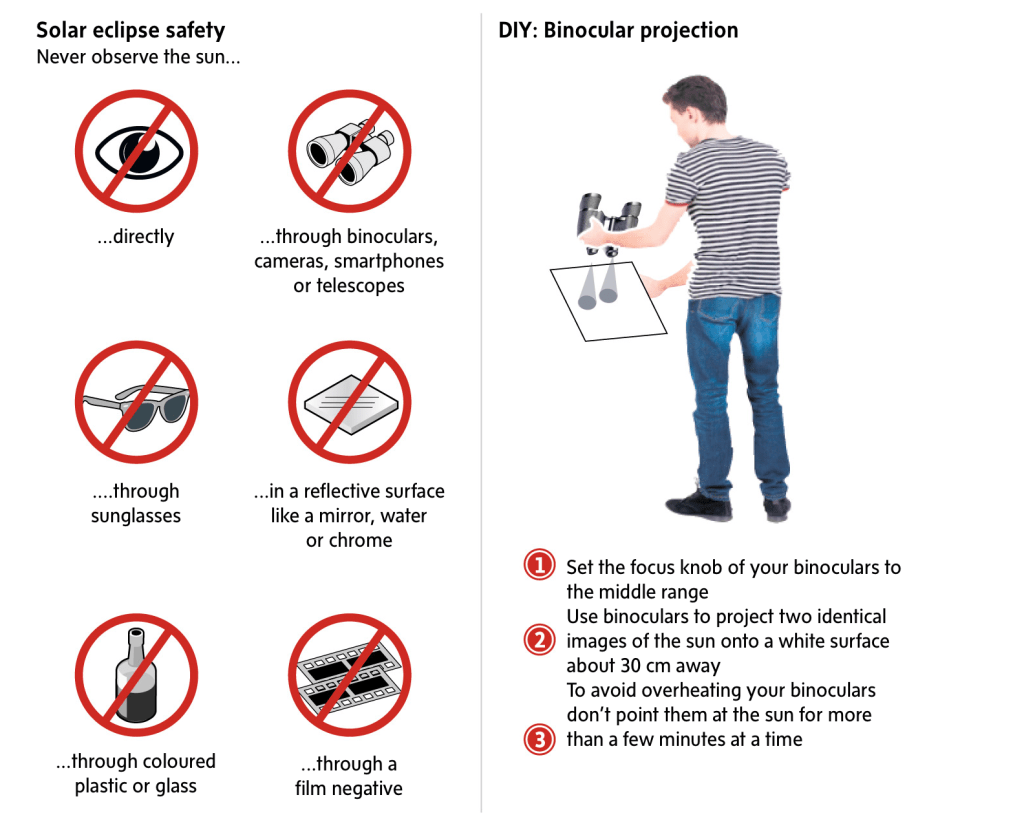
We got special eclipse glasses from school, designed to protect our eyes from the sun’s brightness during the event. Solar eclipses occur when the moon covers the sun, a rare event happening twice a year. Looking at eclipses can be very dangerous, so it’s crucial to keep your eclipse glasses on at all times. During a total eclipse, you can take off your glasses for one to three minutes, but not for longer than 2.5 minutes to avoid damaging your eyes. Also, never use cracked or damaged glasses. The phases of the moon doesn’t affect the eclipse since they are just the reflection of the sun. In the right area, an eclipse can make the sky look like it’s in the middle of the night, pitch dark.
This particular side effect of an eclipse can provide a great opportunity for revolutionary scientific discoveries that can be found by astronomers and scientists.

The most well known case of this is Einstein’s theory of relativity was confirmed during the 1919 eclipse, thanks to observations made by astronomer Stanley Eddington. Without the eclipse, such groundbreaking discoveries would have been impossible.
Most of the scientists observing the eclipse are heliophysists, or sun scientists. October 2023 to December 2024 is actually the Heliophysics Big Year. It’s a global celebration of solar science and the influence our Sun has on Earth, as well as the rest of the entire solar system.
Fun fact: Niagara Falls was expecting over 11 million visitors to see the eclipse!
Another fun fact about eclipses is that Nasa has a live broadcast that follows the eclipses journey through the world, and this year, they added a poll where we could vote if it was the moon’s, the sun, or the earth’s special day, and the moon won.
You see, an eclipse occurs when the moon, sun and earth align, which is fully visible in the band of totality, and is partially visible around the band. Since the moon rotates around the sun at a different angle than the earth rotates around the sun, this phenomenon only occurs about twice a year on average. There was actually a whole debate about the competition, with each side presenting good facts to support their points.

In conclusion, this eclipse has been something special and memorable that we can all remember for the rest of our lives.
 Avatar Dragons
Leave a comment